What is it?
An appliance designed to heat dried flower in a chamber rather than ignite it. It is different from an oil pen or cartridge vape.
Smokegear knowledge guide · For adults
A dry herb vaporizer heats dried cannabis flower to create an inhalable aerosol without intentionally burning the plant material. Unlike an oil-cartridge vape, it has a chamber for loose flower. The three common heating methods are conduction, convection and hybrid.
This guide explains how dry herb vapes work, the differences between devices, what affects flavour and performance, how to maintain one, and the health and safety trade-offs. Vaping is not risk-free. Health Canada guidance ↗
Research-based explainer · Sources checked · See sources and editorial scope
Answer first
An appliance designed to heat dried flower in a chamber rather than ignite it. It is different from an oil pen or cartridge vape.
By contact with a heated chamber (conduction), by hot air passing through the flower (convection), or by combining both (hybrid).
It avoids combustion when used properly, but inhaling cannabis aerosol still carries health risks; long-term outcomes are not fully known.
Choose for your priorities: heating consistency, airflow, size, temperature controls, battery, cleanability and manufacturer support—not a single feature alone.
Understand the device
A dry herb vaporizer is built for loose, dried botanical material, commonly cannabis flower. A heating system warms the loaded chamber so compounds are released into an aerosol that travels through the air path and mouthpiece. A properly operating device is designed to avoid the open flame and intentional combustion involved in smoking.
Most powered devices include a heating chamber or oven, a heat source, an air path and mouthpiece, temperature controls and a battery or wall power connection. Some models use glass stems or removable dosing capsules. Manual models may instead require a flame or induction heater applied to a designated external component; the flower itself is not meant to burn. Actual design varies, so the manufacturer's manual controls what materials and accessories are compatible.
A dry herb vaporizer is not the same as a THC oil vape, a nicotine e-cigarette or a dab rig. Evidence about oils, additives or cartridge metals should not automatically be presented as proof about every flower-only device, although dry-herb aerosol also has risks.
Holds dried flower. Overpacking may block the airflow needed for the device to operate as designed.
Transfers heat through contact, moving air or a combination of both.
Routes the aerosol through a mouthpiece. Residue buildup can restrict airflow and affect flavour.
The comparison that matters
Smoking burns dried flower and produces smoke. A dry herb vaporizer heats flower without intended combustion; an oil-cartridge vape usually heats a formulated cannabis extract. The delivery systems—and some of their specific risks—are different. It is important not to treat evidence from oil cartridges as if it automatically applies to dry-flower vaporizers. Health Canada’s inhalation-accessory guidance ↗ covers the broader categories and related precautions.
| Question | Dry herb vaporizer | Smoking flower | Cannabis oil cartridge |
|---|---|---|---|
| What is heated? | Dried flower | Dried flower, which is burned | Concentrated oil or extract formulation |
| Combustion? | Not intended in normal operation | Yes | Not intended in normal operation |
| Primary inhaled material | Aerosol from heated flower | Smoke from burning flower | Aerosol from heated extract |
| Major caution | Inhalation risks remain; heat and device quality matter | Combustion adds toxic smoke compounds | Extract strength and formulation/contaminants present additional concerns |
No inhaled cannabis method is harmless. Potential differences in lung exposure should not be confused with differences in THC delivery or impairment. Evidence does not establish that every dry-flower device offers the same reduction in risk.
Conduction vs convection
Neither is universally best. Conduction can offer straightforward operation; convection passes hot air through the flower and can promote more even heating in a well-designed device; hybrid devices combine the two. Real-world performance also depends on airflow, chamber geometry, controls and user technique.
Flower touches a warmed chamber or surface. Often simple, compact and quick, but material near the hot surface may heat differently from material in the centre.
Heated air moves through the flower when the device is used. A well-designed airflow system can promote even extraction without relying mainly on contact with oven walls.
Uses heated chamber surfaces and moving hot air together. The goal is to balance responsive heating with thorough contact throughout the load.
| Priority | Conduction | Convection | Hybrid |
|---|---|---|---|
| Heat transfer | Direct surface contact | Moving heated air | Contact + air |
| Design tendency | Can be compact and uncomplicated | Airflow design is especially important | Balances two systems |
| Possible limitation | Hot spots or less even heating | Warm-up and draw technique can matter | Complexity; quality varies by model |
| Best buying test | Read independent device-specific assessments instead of assuming one method always wins. | ||
Format and use case
Form factor is separate from heating technology. A portable vaporizer can be conduction, convection or hybrid; the same is true of some desktop systems. Battery life, temperature adjustment, portability and maintenance are useful decision factors.
Rechargeable, self-contained devices for use away from an outlet. Check real charging arrangements, weight, chamber design and battery serviceability.
Best suited to: Buyers who prioritize mobility.Generally intended for use in one location and often powered from a wall outlet. Consider space, accessories, cleaning and how the device delivers aerosol.
Best suited to: Home-focused setups.Devices heated with an external source, such as a torch or induction heater, rather than a built-in electric heater. Their results depend more on technique, and the cap or other heated parts can remain extremely hot.
Best suited to: Experienced users comfortable with a learning curve.Some vaporizers keep the chamber warm for a timed session; others are designed for shorter heating cycles or individual draws. Session devices can be simpler for a continuous sitting, while on-demand systems may suit irregular use. Neither style determines safety, effectiveness or value on its own.
Controls & expectations
There is no universally correct or medically “safe” temperature for vaporizing cannabis flower. Lower settings on a given device may emphasize flavour and produce lighter aerosol; higher settings may produce a denser aerosol but also increase heat exposure and the risk of an unpleasant or harsh session. Device displays and actual chamber temperatures may differ.
Within a device's approved range, lower settings often produce a lighter experience. Do not assume a specific setting removes inhalation risks.
Warmer operation can change density and taste. Avoid exceeding the manufacturer's limits or attempting to ignite the flower.
Online temperature recommendations are not validated universal standards. Start with your particular device's instructions and be mindful that inhaled THC can cause substantial impairment even without smoke.
Practical overview
These are general operation steps for an adult using legally obtained dried flower. The manufacturer's manual takes priority because chamber size, loading rules, heat sources and cleaning procedures differ.
Confirm that it is designed for dried flower, the battery and charging accessories are undamaged, and removable parts are properly assembled.
Use the grind and loading instructions for your model. Do not pack tightly enough to block airflow or exceed the indicated capacity.
Use the device's controls and allow it to reach the operating temperature before proceeding. Do not apply an external flame to an electric vaporizer.
If consuming cannabis, Health Canada recommends starting with a low-THC product and a small amount, then waiting before using more. Avoid deep inhalation and breath-holding.
Let all parts cool fully before handling the chamber. Do not leave a hot device near children, pets or combustible materials.
Remove loose residue and service removable parts using the approved method; keep liquids out of electronics and charging ports.
Public-health guidance: Health Canada: start low, go slow ↗.
Practical buying questions
The best choice is the one that suits your priorities and is supported by reliable documentation. Marketing words such as “medical-grade”, “pure vapour” or “premium” are not substitutes for evidence about a specific product. Compare the following before buying:
Our separate comparison ranks 12 dry herb vaporizers using five testing criteria; the overview you are reading is a research-based explainer, not another product test.
Ownership basics
Cleaning matters because residue can restrict airflow and affect taste. After the device is fully cool, empty loose flower and remove dry debris using a soft brush if the manual permits it. Clean detachable mouthpieces, screens or stems as specified by the manufacturer. Use alcohol only on parts approved for it; never soak powered components.
Check charging status, chamber loading, appropriate temperature setting, airflow blockage and whether the device has reached operating temperature.
Inspect the screen, mouthpiece and air path after the unit cools. Clear residue in the manner specified for your device.
Stop using the device and check for overheating, burnt material, contaminated parts or a fault. Do not continue operating a damaged unit.
Stop use if the device is swollen, damaged, overheating or behaving abnormally. Consult the manufacturer and relevant safety notices.
Health & responsible use
Vaporizing flower avoids combustion when the device works as intended, but it is not safe or harmless. Smoking cannabis exposes the lungs to toxic combustion products. Health Canada states that cannabis vaping may be less harmful to the lungs than smoking, but warns that vaping aerosol still carries health risks and that long-term effects remain uncertain. This does not prove every dry-herb device is safer, nor does it mean less THC exposure: in one small controlled study, vaporized cannabis caused greater acute impairment than the same THC dose smoked among infrequent users. Health Canada ↗ · Spindle et al., JAMA Network Open ↗
This is general educational information, not medical guidance. Choosing not to inhale cannabis avoids inhalation-related exposure. Health Canada: reducing inhalation risks ↗ · Lower-risk cannabis use guidelines ↗
Frequently asked questions
They are designed to heat flower without burning it. Overheating, faulty operation or misuse can still scorch material; stop if you notice signs of combustion.
Yes. Heating cannabis flower produces an identifiable aroma, although it typically does not create the same lingering combustion smoke as a joint. It is not odour-free.
Not automatically. Convection heats through moving hot air; conduction heats by surface contact. Your experience depends on the specific product's design and performance.
Not unless the manufacturer explicitly allows them and provides the necessary parts. Most flower-only chambers are not designed for liquid oil or cartridges.
There is no universally correct or risk-free setting. Use the manufacturer's approved range; lower or higher settings change performance but do not remove health risks.
Remove loose residue after use when cool and follow the maker's schedule for deeper cleaning. Frequency depends on the device and how much residue builds up.
It can. A controlled study of 17 adults who rarely used cannabis found stronger acute effects and higher blood THC with vaporized cannabis than with the same THC dose smoked. The finding may not generalize to all devices or users. Read the study ↗.
There is no blanket rule. Both include devices with different designs, power sources and performance levels. Evaluate models individually.
“Vaporizer” is broad. In everyday retail language, “vape pen” often means a cartridge or extract device, while “dry herb vaporizer” means a device with a chamber for flower.
That depends on your budget and priorities. In the user-reported results from Smokegear’s separate three-adult panel, VENTY scored highest for performance (9.4/10), and Utillian 850 was the recommendation for most buyers (9.2/10). Read the full comparison and methodology.
Transparency
This article is a research-based editorial explanation, not a claim that Smokegear independently tested the health findings, temperature ranges or general industry statements. It draws on published health information and clearly separates public-health guidance from product education. Any Smokegear device-test scores mentioned here link to our separate three-person comparison.
Sources accessed . Technology, safety notices, laws and manufacturer instructions may change. Verify current documentation before publishing specific model claims.
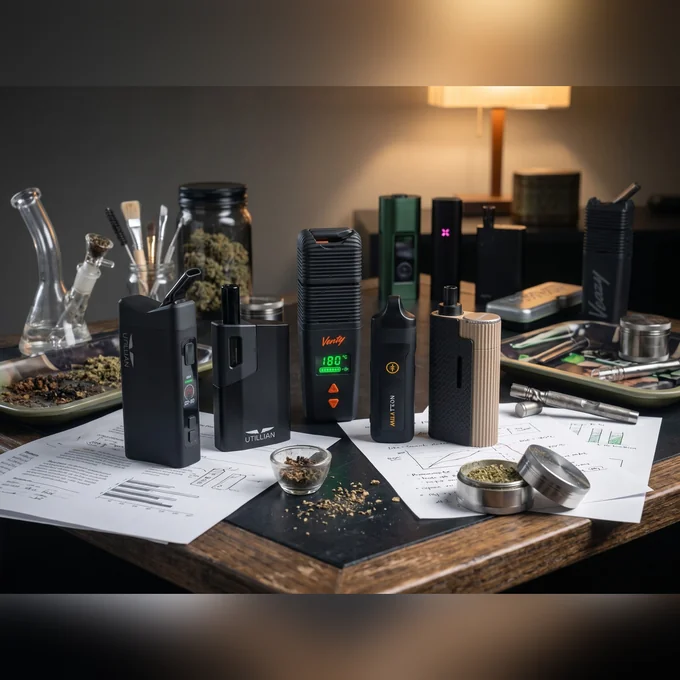
How are these comparisons evaluated? Read the Smokegear testing methodology and learn which device categories have four-user or three-user test panels. Product artwork is illustrative and is not evidence of laboratory measurements.